
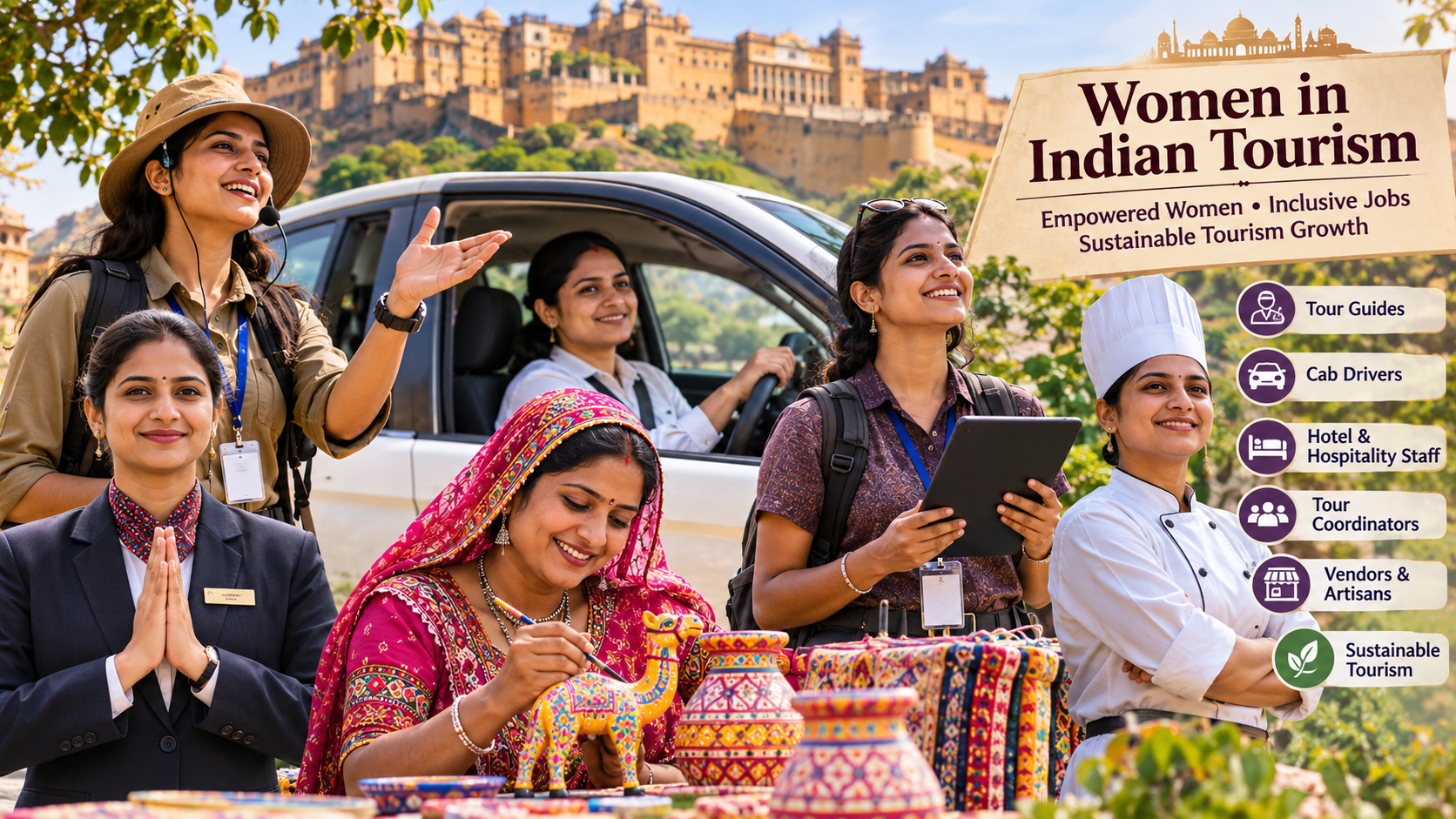
Women in Indian Tourism: The Untapped Strength Behind Sustainable Tourism Growth
By Team Guidewala · 17 November 2026
GUIDEWALA | Tourism Insights & Industry Perspectives
A tourism career can begin at a hotel reception desk, behind the wheel of a vehicle, in a village workshop or on a heritage walk. It can also lead to managing a destination, owning a travel company or deciding how an industry invests in its people.
Women belong across that entire range of work. The opportunity is not simply to recruit more women into tourism, but to create conditions in which they can earn fairly, develop expertise, build businesses and progress into leadership.
For India, that means looking beyond promotional campaigns and asking practical questions. Who receives paid assignments after training? Who can access customers and finance? Whose working hours are manageable? And who has a voice when decisions are made?
Sustainable tourism should create worthwhile careers for the people who deliver it. Women’s participation, professional choice and economic independence are part of that responsibility.
Tourism Growth Should Open Doors to Better Work
Tourism connects accommodation, transport, guiding, food, crafts, technology and destination management. Each creates different entry points, skill requirements and opportunities for progression.
A CII–EY whitepaper announced in December 2024 projected a need for approximately 61 lakh additional workers in India’s tourism and hospitality sector by 2036–37, including about 15 lakh women. These are forecasts of additional workforce requirements, not jobs already created, guaranteed future vacancies or a measure of women’s current share of employment. Read CII’s announcement.
Such projections raise an important question for employers and training providers: what will make these possible opportunities accessible and worth pursuing?
Recruitment figures tell only part of the story. Pay, reliable assignments, working conditions, retention and promotion matter too. A training certificate has limited value if its holder cannot obtain experience or find customers.
Women Tour Guides: Expertise, Opportunity and Choice
A professional guide researches, interprets, communicates and manages the practical flow of a visit. These are learned skills, and women should have the same opportunity to develop and demonstrate them as any other aspiring professional.
A broader guiding community can bring a wider range of interests and lived experiences to heritage interpretation. That does not mean women should be expected to tell only “women’s stories,” or that a person’s gender determines their knowledge. Every guide should be able to specialise in the subjects that interest them, from architecture and archaeology to natural history, religion and contemporary culture.
Some travellers prefer a woman guide. Where a suitably qualified professional is available, offering that choice can help match the service to the traveller’s preference. Selection should still consider destination knowledge, credentials, language, communication and relevant experience.
Useful support for new guides includes:
- Clear information about relevant training, certification and site requirements.
- Destination research, interpretation and language practice.
- Paid opportunities to observe and co-lead tours.
- Transparent assignment procedures and agreed guide fees.
- Mentoring that continues beyond the first booking.
The aim should be a professional career with a route to advancement, rather than occasional visibility in a promotional photograph.
Women Drivers: A Career Needs More Than Driving Lessons
Tourist driving combines vehicle skills with route planning, time management, passenger communication and professional judgement. A woman who wants to enter this field may need support at several stages: training, relevant licensing, access to a suitable vehicle, supervised experience and dependable bookings.
Operators should consider the full working day. Early pickups, delayed flights, waiting time, rest breaks and overnight accommodation all affect whether an assignment is practical. These conditions deserve attention for every driver, with individual concerns discussed rather than assumed.
A workable pathway might begin with supported local assignments and expand according to the driver’s qualifications, experience and preferences. Airport transfers, city sightseeing and outstation journeys should not be allocated on the basis of gender stereotypes.
A woman driver is a professional choice, not a safety guarantee. Vehicle condition, driver competence, realistic schedules, accountable operations and reliable support remain essential regardless of who is driving.
Hospitality Careers Should Reach Every Department
Women should have access to the full range of hotel and hospitality careers: operations, finance, revenue management, technology, procurement, culinary leadership, engineering, security and general management, as well as guest-facing roles.
Employers can make progression clearer by publishing job requirements, explaining promotion criteria and offering access to assignments that build management experience. Training should lead somewhere, with feedback, practical responsibilities and visible next steps.
Predictable scheduling, workable shift arrangements and support for employees returning after a career break can also improve access. Flexibility is most useful when it is designed around the job and employee’s circumstances, rather than offered at the expense of pay or advancement.
Women should not have to remain in a narrow category of work because it is considered traditionally suitable for them. Career choice should follow ability, interest and opportunity.
From Travel Coordination to Business Ownership
A successful tour depends on work that visitors may never see: preparing a route, checking reservations, coordinating suppliers, answering questions and handling changes. These responsibilities can provide a foundation for careers in destination operations and travel entrepreneurship.
Digital tools can make customer communication and business administration more accessible, but an online presence alone does not create a viable enterprise. A new business also needs pricing skills, clear terms, reliable suppliers, cash-flow planning and a way to reach suitable customers.
Women starting tourism enterprises can benefit from practical mentoring in:
- Costing a service and allowing for administration, cancellations and quieter periods.
- Preparing quotations, invoices and written booking confirmations.
- Assessing supplier quality and negotiating clear arrangements.
- Managing enquiries and maintaining professional digital profiles.
- Identifying relevant finance and support programmes, subject to eligibility.
Remote work may suit some roles and individuals. It should be an option, not a reason to keep women away from field operations, commercial negotiations or leadership.
Rural Experiences: Recognise the Work Behind the Welcome
A cooking session, craft workshop or homestay can connect visitors with a place through the people who know it. For women who choose to provide these experiences, tourism may offer a route to paid enterprise.
But the commercial arrangement deserves as much attention as the visitor experience. Who sets the price? Who pays for ingredients and materials? Is preparation and cleaning time included? Who receives the payment, and can the host decline a booking?
For example, a paid cooking experience should account for shopping, preparation, teaching, food, cleanup and administration—not just the time the guest spends in the kitchen. That is an illustrative pricing principle, not a description of a specific GUIDEWALA programme.
Hosts should decide which spaces, activities and photographs they are comfortable sharing. Visitors are guests in a working home or community, and participation should remain voluntary.
These experiences become more credible when women have a meaningful say in the design, price and income, rather than simply supplying additional unpaid labour.
Address the Barriers Alongside the Training
The obstacles to a tourism career vary by location, household circumstances, income, disability, experience and type of work. Women are not a single group with identical needs. Support should begin by listening to the people expected to use it.
Working Hours, Mobility and Caring Responsibilities
Early departures, late finishes and travel away from home can affect access to work. Predictable rosters, dependable transport and practical discussion of caring responsibilities can help make opportunities usable. Employers should avoid assuming that every woman wants the same schedule.
Workplace Safety and Respect
Clear professional boundaries, accessible ways to raise concerns, prompt responses to complaints and reliable operational support matter. Workers should know whom to contact when a guest, supplier or colleague behaves inappropriately. Safety measures should enable participation rather than become a blanket reason to exclude women from assignments.
Finance and Access to Customers
Training is only one cost of entry. Equipment, transport, marketing and the gap between delivering a service and receiving payment can be significant. Mentoring should address these realities, including transparent platform fees and realistic borrowing decisions.
Fair Assignments and Advancement
A person can be recruited yet still receive fewer opportunities to build experience. Businesses should examine who receives valuable assignments, who is offered training and how promotion decisions are made. Published criteria and regular review can make these processes easier to understand.
Government Initiatives: Connect Learning with Livelihoods
The Ministry of Tourism’s Paryatan Mitra and Paryatan Didi initiative recognises the contribution of people who interact with visitors. In its March 2026 update, the Ministry described a particular emphasis on training women and youth for opportunities such as homestays, food experiences and different forms of guiding. Read the official update.
This provides a useful starting point, but programme participation should not be treated as proof of long-term employment or higher earnings. Those outcomes require separate follow-up.
Training providers and businesses could work together on paid placements, mentoring, introductions to customers and feedback after the first assignments. Participants should understand what support is actually offered; completing a course should never be presented as a guaranteed job unless that commitment genuinely exists.
Rajasthan: Opportunities Worth Developing
Rajasthan offers many settings in which tourism businesses could develop more inclusive recruitment and supplier relationships. These are opportunities to explore, not claims that every service is already available.
In Jaipur, possibilities include heritage guiding, museum interpretation, destination operations, visitor transport and craft-related experiences. Jodhpur and Jaisalmer offer scope for hospitality, cultural interpretation and professionally managed rural and desert activities. Udaipur’s tourism businesses span accommodation, guiding, events and travel coordination.
Smaller destinations also deserve attention. Local training partnerships can reduce travel barriers, while connections with established operators can help new professionals reach customers.
The strongest programmes would begin with actual demand, listen to prospective participants and offer a route from learning to paid work. A course designed without considering jobs, customers or working conditions risks leaving its graduates with few practical options.
What Tourism Businesses Can Do Now
A business does not need a large campaign to begin making useful changes:
- Review recruitment: describe the skills required and use channels that reach a wider pool of candidates.
- Offer paid experience: provide structured entry-level work, clear supervision and feedback.
- Agree fair terms: record fees, hours, expenses, cancellation arrangements and payment dates.
- Make support accessible: ensure workers know how to report a problem and obtain operational help.
- Build supplier relationships: consider women-owned businesses on service quality and commercial fit, with transparent selection and payment.
- Open routes to leadership: provide access to management training, commercial responsibilities and promotion.
- Ask what is working: listen to employees and independent professionals, then adjust arrangements where needed.
Photographs and empowerment slogans cannot demonstrate whether these practices are in place. Everyday decisions about work and money provide the more meaningful evidence.
Measure Progress Beyond Headcounts
A useful review should look at outcomes over time, including:
- Whether trainees move into paid work relevant to their skills.
- Earnings and assignment frequency across busy and quiet seasons.
- Retention, promotion and access to leadership responsibilities.
- Payment timeliness and business continuity for independent suppliers.
- Whether workers feel able to raise concerns and receive a response.
- The amount of decision-making control entrepreneurs have over their services.
These are suggested measures, not reported results. Collecting information should be proportionate and protect privacy, especially when discussing earnings or workplace concerns.
The Traveller’s Role
Travellers can support professional opportunity through informed choices. If you prefer a woman guide or driver, state that preference early and ask the provider to confirm availability for your destination, date and language. Avoid assuming that a request can always be fulfilled.
When booking a locally hosted experience, ask what the price includes, respect the agreed timing and obtain permission before photographing participants. Specific, honest reviews can help good professionals build their reputation.
Choosing a service should still involve checking qualifications, suitability, inclusions and booking terms. Our guide-booking checklist explains the questions to ask.
The GUIDEWALA Perspective
At GUIDEWALA, we believe that a stronger tourism industry gives skilled people a fair opportunity to be discovered, booked and recognised for their work. Women should be able to pursue that opportunity as guides, drivers, hospitality professionals, suppliers, entrepreneurs and leaders.
This is part of a wider responsibility to the local people who sustain India’s tourism economy. Inclusion becomes meaningful when it affects the quality of work and the terms on which people participate.
When planning your visit with GUIDEWALA, share your destination, dates, language and any preference for a woman professional. Ask the team to confirm suitable availability and the proposed arrangements before booking.
From Participation to Lasting Careers
The ambition should be clear: women must be able to enter tourism on fair terms, use their skills, receive a proper return for their work and choose how their careers develop.
That requires more than encouraging women to apply. It requires employers, operators and training institutions to connect opportunity with workable conditions, paid experience and progression.
A tourism industry that takes these responsibilities seriously can draw on a wider range of talent and build stronger relationships with the communities it depends on. Its success should be visible in the careers people can sustain—not only in the destinations it promotes.